

Enduring a hail storm, unprotected lanes and navigation issues, I biked across King County on Feb.17, 2026. Starting in Mountlake Terrace and ending in Sumner, the 55-mile ride took about five hours.
I use trails in the region for various purposes, but mainly biking. Since moving to the Seattle area in 2022, I have ridden almost all the main trails in King County. As the county currently boasts more than 175 miles of regional rail, it is clear to me that the Seattle metropolitan region has invested heavily in car-alternative protected trails. I believe that the county must keep expanding and enhancing the trail network and make it a viable solution to addressing traffic congestion and environmental pollution.
“Even though I know Seattle is one of the best cities in the US for biking, there’s still so much room for improvement,” junior Aiden Roberts said.
Roberts bikes around Seattle as a way to stay active, and utilizes trails like the Interurban. Although Roberts enjoys the trails, outside of them, he feels that the area is still not friendly enough to cyclists.
“A lot of cars either cut off bikes, go way too close to the bikes at the speed they’re going, which is dangerous and pretty scary,” Roberts said.
Given the high-speed of cars along unprotected bike lanes, it is clear to Roberts and others that the region needs the infrastructure to support bikes.
“What I would love to see is just trails and routes that are safe and protected,” Dean of Faculty and Visual Arts teacher Ty Talbot said.
Talbot has been riding the Burke-Gilman Trail since 2004, and has noticed that the trail has improved in some ways and gotten busier.
“With e-bikes and with scooters, like e-scooters, you see a lot more commuters, and you see them going a lot faster,” Talbot said.
Despite the chaos of Lime bikes and scooters, Talbot is right that trails in the region serve a lot of people.
“With more than 3 million annual users, the Burke-Gilman conveys a traffic volume equivalent to many local arterials,” a Kiro 7 news article said.
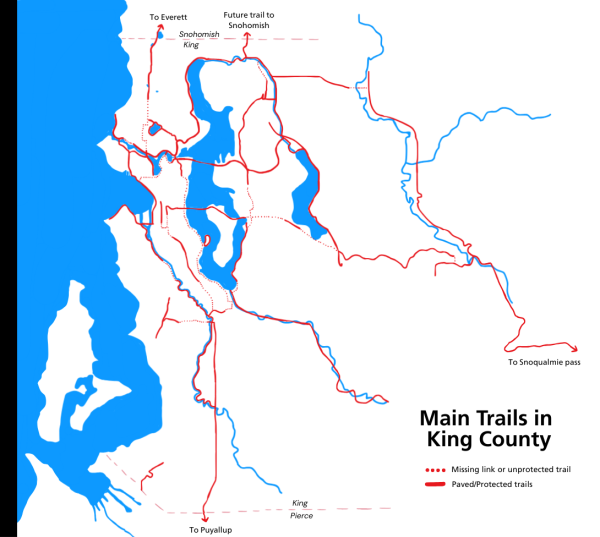
The demand for trails is clear, and non-vehicle transportation infrastructure serves a role in environmental protection by getting people out of their cars and limiting carbon emissions.
“As someone who’s really interested in salmon and protecting our native salmon populations, I know that the less rubber on the road, the better,” junior Orrin Spiess said.
Spiess commutes from his home to UPrep on his bike almost every day and appreciates the work the city and county have put into expanding trail infrastructure and growing the bike network.
“Having been to other cities, I think our bike network is amazing in comparison, and there’s obviously still room for improvement,” Spiess said. “I’m really proud of the city’s job in recent years to really beef it up and get it to where it is today.”
A survey conducted by the Puma Press found that out of 32 respondents across the UPrep upper school student body and faculty, 84.4% use trails to walk, 46.9% to run, and 37.5% to bike.
“I usually use them mainly for running and trail running, practicing on hills, and coordination and ankle stability within running,” junior Penelope Woodman said.
Woodman is not only a committed cross-country and track athlete, but also an advocate for clean and safe trails, as she picks up trash with her running group.
“So I’ve been running, and we do like trash pickup as we run sometimes, depending on whether we borrowed gloves, because it can be dangerous,” Woodman said.
Woodman is correct that some parts of the region’s trail network are neglected. On my bike ride from Snohomish County to Pierce County, several parts of the Interurban South (a trail which runs from Tukwila to Puyallup) in Kent were surrounded by trash on both sides of the trail.
The biggest upgrade that the King County trail network needs, in my opinion, is ensuring that users are able to safely reach trails from neighborhoods and ensuring that “missing links” are connected. Infamously, the Burke-Gilman Trail is not continuous through most of Ballard’s downtown core, as cyclists are forced to bike on sidewalks or on arterials. These missing links exist elsewhere, in places such as downtown Bellevue along the Eastrail, the Marginal Place link in the South Park neighborhood, and the lack of east-west bike routes north of Green Lake.
After riding for 55 miles across the region, I realized that if King County truly wants to make biking and running more widely accessible and enjoyable, it must protect and finish connecting the trail system for the millions of people who rely on it every year.
