
TICKETS
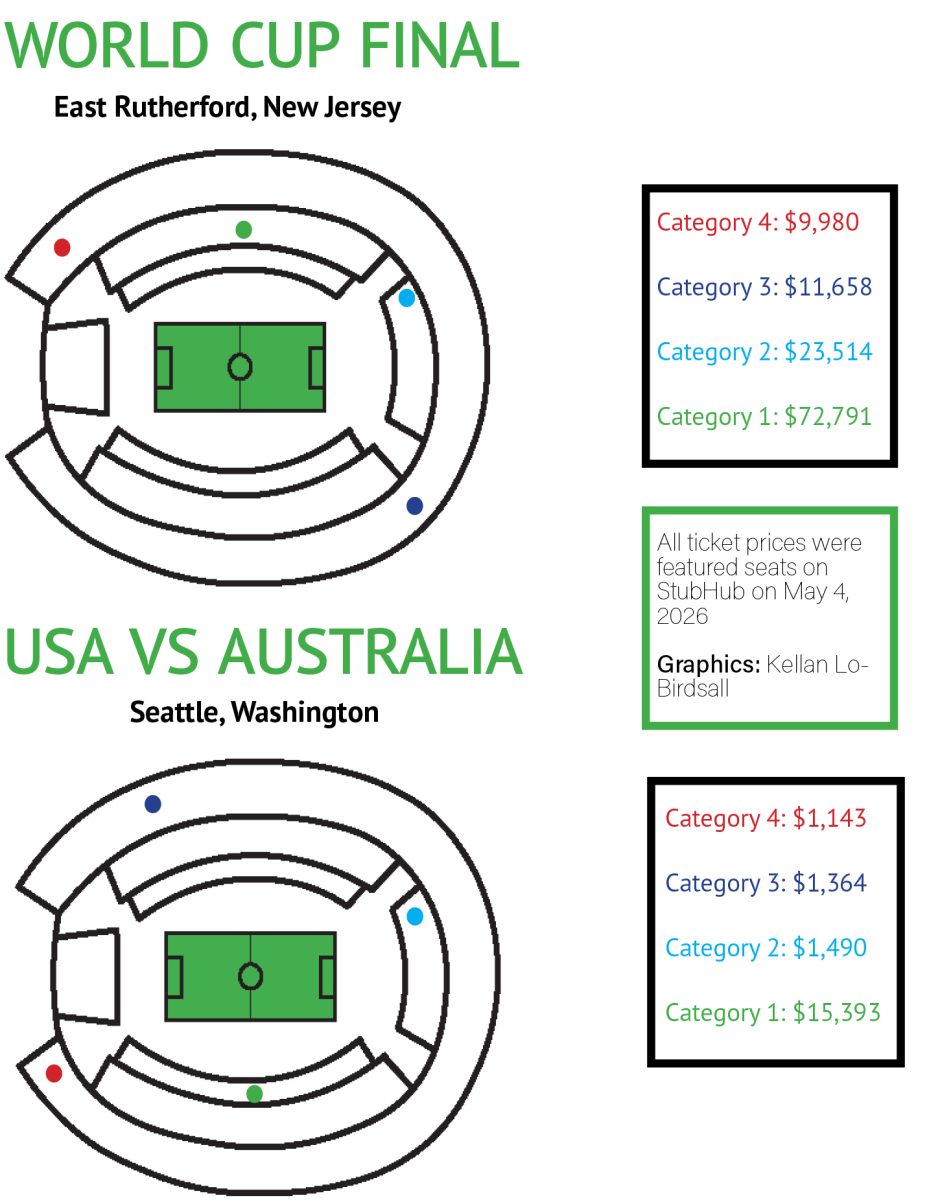
Alongside the excitement, there are concerns regarding 2026 World Cup ticket prices. On June 19, the USA plays Australia at Lumen Field, making one of the most popular matches among fans. The lowest price for this game on StubHub, a popular ticket reseller app, is at $1,104 as of May 5.
Sophomore Zander Cook is hoping to buy resold tickets to the USA vs. Australia game.
“I definitely want to go to the USA game,” Cook said. “But you know, tickets are quite expensive and a little bit of a mess.”
To get tickets at face value, you had to enter a lottery system alongside 508 million other requests.
If you managed to win this lottery, you got the opportunity to buy face value tickets.
The best ticket category for group stage in Seattle are going for roughly $500-700 face value, according to Seattle FIFA World Cup.
“I would bet some people are probably using their life savings to come be at this event,” soccer coach Niki Harris said. “If it’s supposed to be open to the world, I think they should make it more affordable.”
The lottery system closed on Jan. 13. For the 2026 World Cup, FIFA lifted the restriction of keeping all tickets at face value. This means, for those who didn’t win a lottery ticket, resale prices can even 10x in price, according to The Guardian.
“I feel like as a soccer fan myself, that they should really make it accessible for everybody,” Zander said. “Broaden the game so that other people enjoy the experience.”
Harris notes that FIFA’s concerns are focused on profits.
“You want to sell out games,” Harris said. “Having a full stadium has to be the priority, and I’m hopeful that they take steps for that to happen.”
Ninth grader Oliver Simpson, who successfully bought tickets by joining the FIFA lottery on eight different accounts, is not worried about filling seats for the USA games.
“I think specifically for the United States games, every seat is going to be filled,” Simpson said. “You know, red, white, and blue all over the stadium.”

Political Tensions
Harris still hopes the tournament will provide the opportunity for communities to unite through the game they love, considering the diplomatic tensions between the U.S. and participating countries.
“The World Cup is supposed to bring people together,” Harris said. “I’m interested to see if that’s going to be able to happen.”
Simpson points to political tensions that could impact the World Cup, especially the Egypt vs. Iran game that at Lumen Field.
“Egypt vs. Iran game is going to be controversial, so I don’t think anyone’s gonna show up,” Simpson said.
For Naysan Sedghi, who has family in Iran and is planning on attending World Cup games, these tensions feel unavoidable.
“The political tensions definitely do influence the games themselves. So I bet there’s definitely going to be a lot more hatred and people not supporting Iran,” Sedghi said. “Or hate watching Iran just because of the political situation in the country.”
On March 11, Iran sports administrator Ahmad Donyamali stated that it is not possible for Iran to participate in the tournament after the U.S. strikes on the nation.
Despite this, on April 20, FIFA president Gianni Infantino affirmed that Iran will be playing in this World Cup.
“Of course, Iran will play in the United States of America. The reason for that is simple; because we have to unite. We have to bring people together,” Infantino said in an article by the Guardian. “There are enough people who try to divide… If nobody tries to unite, what will happen to our world?”
Local soccer journalist Jeremiah Oshan believes that immigration policies will make it impossible for Iranian fans to attend. As of January 1, travel restrictions prevent fans of the qualified nations, Iran and Haiti, from gaining US visas for international travel, according to the American Immigration Council.
“It’s obviously going to be almost virtually impossible for a fan of Iranian soccer to come to the United States unless they are American,” Oshan said.
Along with Iran, Oshan is concerned about attendance at Qatar and Bosnia-Herzegovina games.
“It’s really hard for me to imagine how any of these internationals are going to get here because of the really outrageous visa processes that we’ve put in place,” Oshan said.
ICE Acting Director Todd Lyons stated the agency would play a “key part” in security for the tournament, prompting widespread concerns, according to a New York Times article. Oshan believes that ICE will heavily affect these traveling fans.
“Even if they come in totally legally, ICE will – in the best case – just hassle them,” Oshan said. “Worst case, they might actually get sent to an ICE facility and be held there for an indefinite period of time.”
Naysan Sedghi attended a FIFA Club World Cup game at Lumen Field last June.
Both he and his father brought their passports in case they were confronted by ICE agents.
“That was the first time that I ever had to take my passport out in public,” Sedghi said. “I feel like I’m being watched at all times.”
Now, as he prepares for the 2026 World Cup, that concern has not gone away.
“I will be bringing my passport to the World Cup games that I will be attending,” Sedghi said. “ ICE definitely limits my ability to fully enjoy a soccer game.”
Sedghi criticizes the amount of power politics plays in soccer.
“I think politics should be separated from our beautiful game,” Sedghi said.

