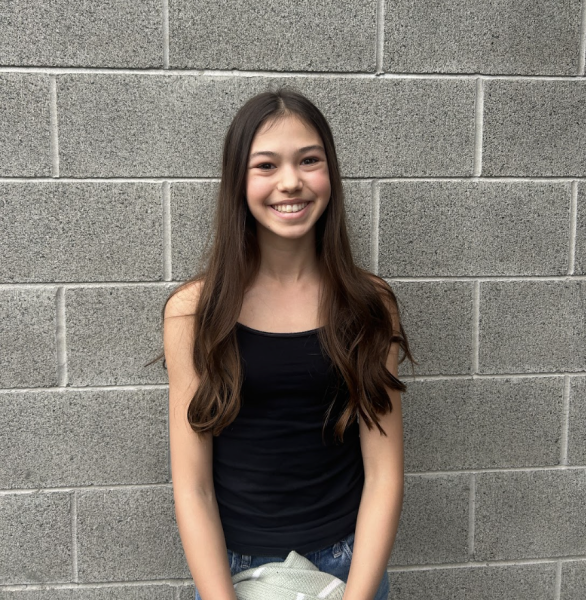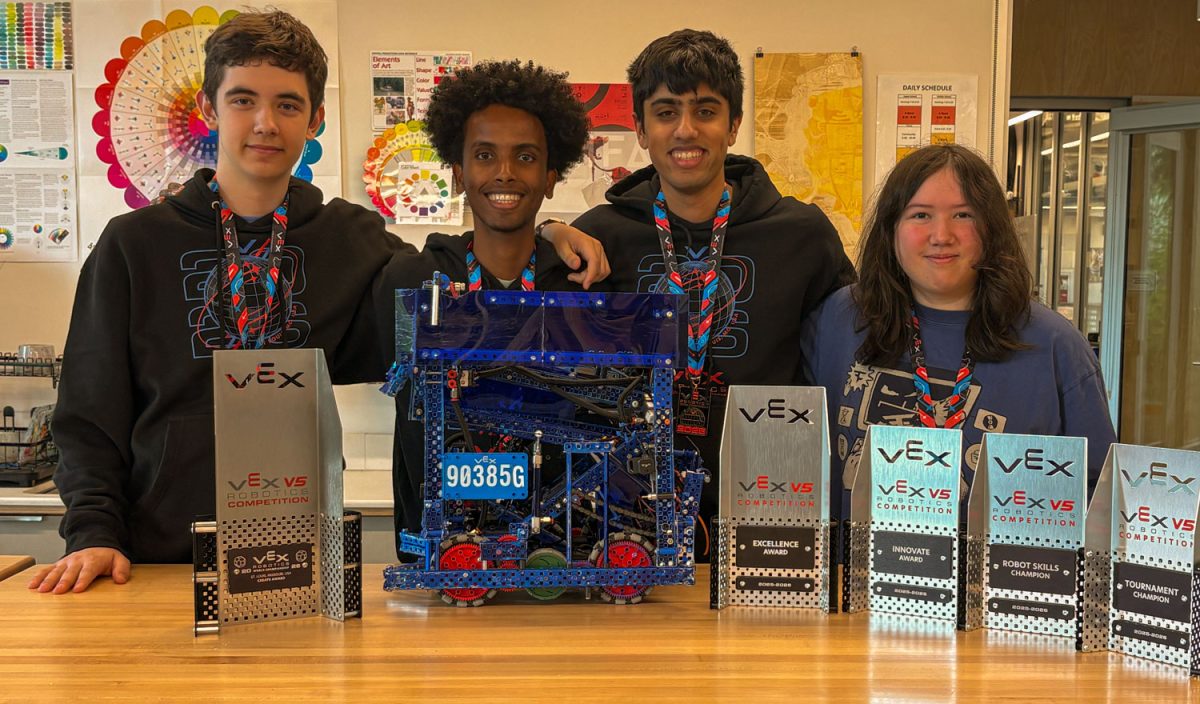
While UPrep students were attending classes, completing homework and sitting through assemblies, the monitor in the ULab Programs office stayed tuned to the VEX Robotics World Championship, where a team of four UPrep students competed. A constant stream of Schoology posts from Director of Innovation and Experiential Education Brian Gonzales kept the community updated, and in some classes, teachers streamed the matches on their projector screens. Seniors Mohamed Farah and Niam Patel, junior Ariel Wagner, and ninth grader Henry Cooke are the four who make up team 90385G, traveling to St. Louis from April 20 to April 25.
“We were really happy to hear about and watch videos of classes watching our matches,” Wagner said. “We got videos from people in history, English, and physics classes.”
As for the road there, Academic Technology Program Manager June Peters, a chaperone on the trip, attributes the success of the program to two things: the hard work of Farah and Patel, the seniors on the team who have revived the program since the pandemic, and the addition of an extra hour to the teams’ daily practice, bringing it from one and a half hours to two and a half.
“It’s not just building robots, there’s programming, there’s project management, there’s teamwork, and, of course, competitiveness,” Peters said.
Each year, VEX tournaments take a different form, forcing students to learn new ways to program, practice, and drive. This time, teams had to use their robots to put balls into plastic tubes raised off of the ground, which are called goals by the students. Peters appreciates the variety and diversity of tournament styles.
“If you’re in it for a few years, you learn a whole bunch of different stuff,” Peters said. “You have very different challenges to solve.”
To prepare for worlds, teams practiced against each other and developed their robots further and each member of the team had a more specific job.
“I did a lot of practice driving, because that’s an important thing, and I’m the driver for the team,” Patel said. “And then Henry Cooke, who’s the coder, did a ton of coding, of making new algorithms, making better routes, [and] making it more consistent.”
Before the start of the trip, Peters said they hope the team can win an award, but they realized it will be hard, with the UPrep team facing skilled opponents, notably from California, Michigan and China. During spring break, Patel said that he and the team had a more specific goal.
“There’s 10 divisions, so our goal is to make the round of 16, which is the top 32 teams. So that’s our goal. That’ll be quite hard, but we’ll try for it,” Patel said.
In the first few days of competition, the team exceeded their goal. 90385G was ranked number 5 going into the round of 16 with a 10-2 record. On April 22, Cooke sent a quick summary of how the first few days had been.
“It has been pretty insane,” Cooke said. “The scale of it is absolutely overwhelming; it’s really cool to talk to and play with teams thousands of miles away from us.”
By the end of worlds, 90385G was 11-3, having made it to quarterfinals and coming home with a trophy and lots of experience, from meeting other students to engineers from NASA.
“[Other teams] bring a different perspective than we do here in Seattle,” Patel said. “It was very fun to play all these different types of strategies.”
Patel hopes that the recognition from worlds helps the robotics team grow into the future.
“Definitely very good exposure,” Patel said. “We’re kind of sharing with the school, and the school [is] kind of following along.”