
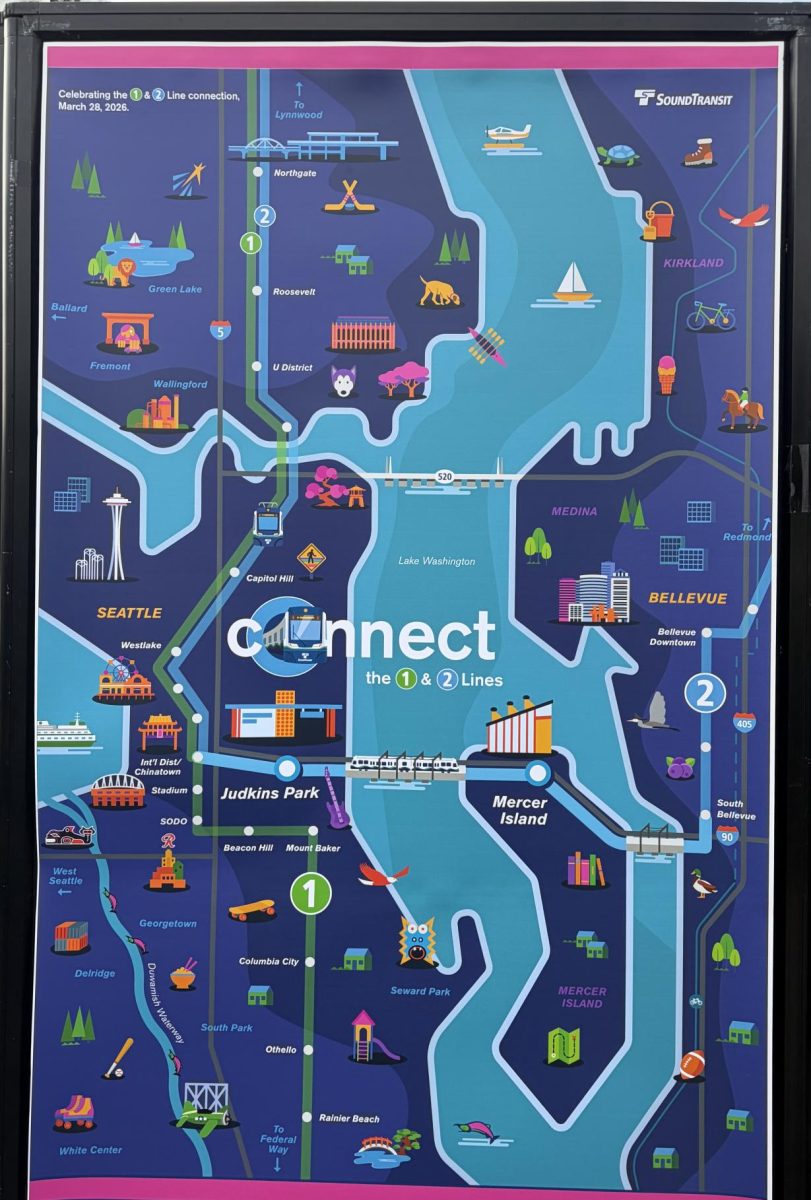
Passed by voters in 2008 and originally scheduled for completion in 2023, the first light rail line on a floating bridge opened for service on Saturday, March 28, 2026. Members of the public, volunteers and local representatives highlighted the importance of a light rail connection across Lake Washington.
Katie Wilson, the mayor of Seattle, has been a transit advocate since co-launching the Transit Riders Union in 2011. Wilson describes the opening of the East Link project as beneficial for the region and a convenience for herself.
“As someone who doesn’t own a car, living in Seattle for the last 20 years, getting to the Eastside is so hard. This is going to open up the region in a way that’s going to change people’s daily lives,” Wilson said.
Randy Harlow, executive project director for East Link, emphasized the need to bridge population centers otherwise only connected by car.
“It means the connection of more people and more places,” Harlow said. “[East Link] was always the linchpin of ST2.”
ST2 or the Sound Transit 2 initiative, promised voters an extension of light rail from the University of Washington to Lynnwood City Center, Sea-Tac Airport to Federal Way and Downtown Seattle to Microsoft Headquarters.
The Puma Press also spoke to Ron Lewis, who served as project director for the East Link project from 2012 to 2018.
“It was design, early construction, it was right-of-way acquisition, a lot of work with communities to get their input on the stations,” Lewis said.
When ST2 was first proposed, some people on Mercer Island resisted the idea of getting light rail access on the island, citing the possibility of an increase of crime and traffic near Interstate 90.
“Projects of this magnitude always have pockets of resistance, and we look at that as opportunities to work with those communities, help them see what the upside of projects like these are, and then also listen to what their concerns were,” Lewis said. “In the case of Mercer Island, they were concerned about the loss of access to the center roadway and what that meant for traffic.”
Nonetheless, the East Link project was approved by voters and construction began. David, an employee of Sound Transit and a passenger assistant for opening day, described East Link as a crucial connection, above all else.
“As I rode over here this morning, when we got down onto the lake, everybody on the train cheered. So I think it means a lot to the region,” David said.
The Eastside of Lake Washington has long been somewhat isolated from Seattle. Before East Link, the only convenient way to cross Lake Washington was by car on Interstate 90 or State Route 520, or by semi-frequent bus connections (all of which are prone to delays in traffic during rush hour). The opening of the East Link project means that Seattle and Bellevue are now less than 25 minutes apart by train.
