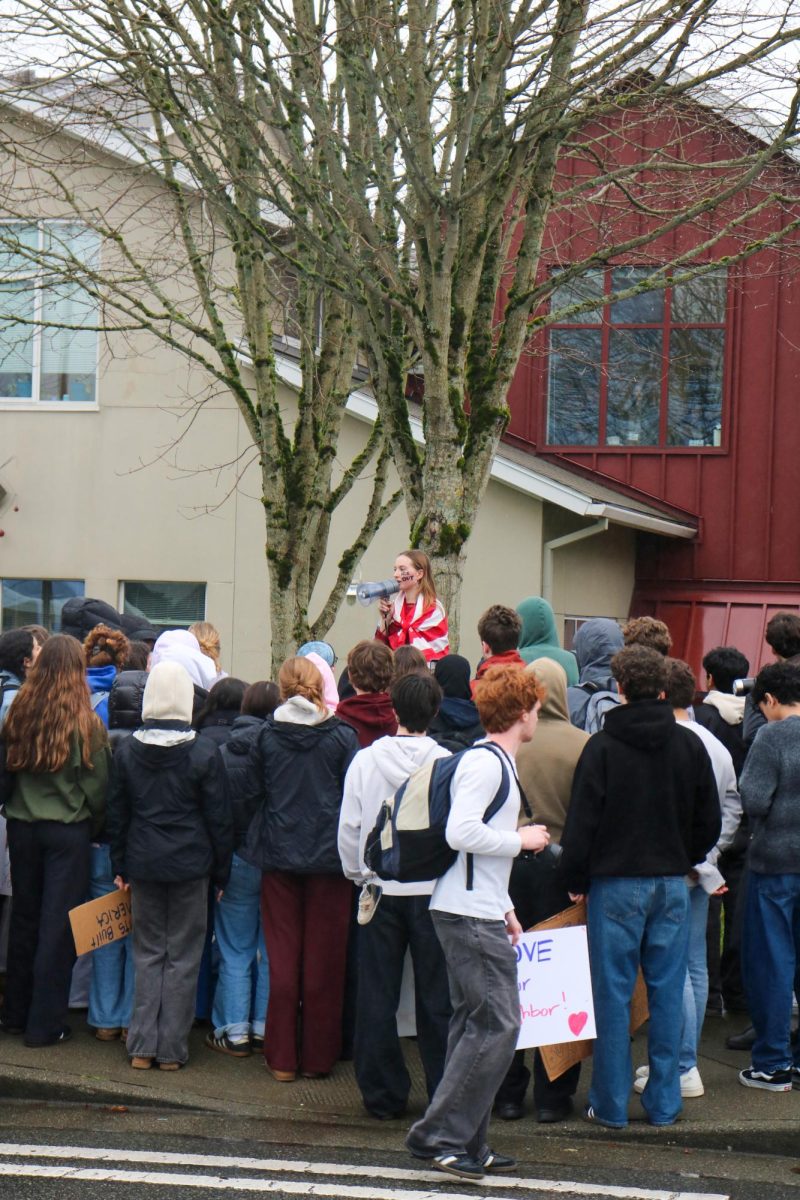
Crowds chanting, cars honking, ink dripping off rain-soaked posters. This was the scene at Dahl Field on Jan. 30th, where hundreds of UPrep students walked out of class to protest the actions of ICE and the border patrol.
“ICE is using a dragnet style operation of picking up as many people as possible,” said history teacher and Sophomore Grade Dean Arron Sokoll. According to Sokoll, in Minnesota “people are being suspected of being undocumented, and then are being detained for hours, sometimes for days, without the agents even considering their immigration papers.”
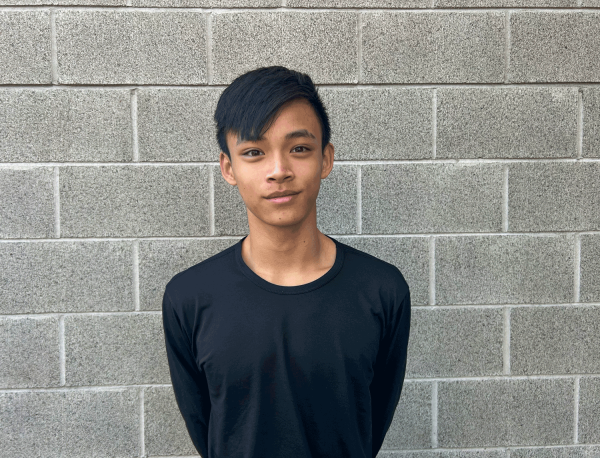
In response to the actions of federal agents, students, including Bryce Hanewall, organized a protest.
“I really wanted to allow students to participate in some way, to use their voices,” Hanewall said. “And to know that they can contribute.” Still, Hanewall was surprised at the turnout.
“I remember initially we said that we’d be happy with 30 people,” Hanewall said. “We probably had over 200 people.”
Hanewall cited the people killed by ICE as a key reason to organize the protest.
As of the 28th of January, at least 8 people have been killed by federal immigration authorities, including those who posed no plausible threat to those authorities, according to the American Immigration Council.
As a result, Hanewall fears for the safety of her community.
“With ICE irresponsibly killing people, [they] think they have authority just because they’re hidden behind a mask,” Hanewall said.
As for student safety at UPrep, Head of School Ronnie Codrington-Cazeau provided the Puma Press with a step-by-step procedure the school would follow if ICE did show up looking for a student.
“Federal immigration officers are only allowed on campus if they have a warrant with a specific name on it,” Codington-Cazeau said. “They are not admitted into the building, instead, a senior administrator or head of school will come to the main entrance to talk to the officers. If the warrant identifies a child, we do not release that child until a parent is called.”
However, if they did try to enter using force, the school would be put into lockdown, and UPrep would contact the police, according to Codington-Cazeau.
Sophomore Brighton Ross wants to see immigration authorities change their tactics to ensure the safety of American citizens.
“No one thinks border control isn’t important, but I think everyone would also agree that we should respect people’s dignity and lives,” Ross said. Sokoll believes that citizens should make their voices heard if they disagree with the government’s behavior. “I absolutely 100% support people’s right to protest, full stop,” Sokoll said. “On top of that, as an expression of free speech, freedom of assembly, you have constitutional rights, and those should be absolutely supported, especially as a civics teacher.”
In a Schoology post published by Head of Upper School Susie Wu before the protest, Uprep informed students about the potential consequences that protesting students could face. The post states that “the protest will be an unauthorized absence from class,” and “students who participate in the walkout will be unable to participate in their games and in the tailgate since they will have an unauthorized absence from school.”
Hanewall feels like the post was aimed at stifling the protest.
“The tone of the email and the way it was written was so suffocating; trying to tighten what we could do was hurtful,” Hanewall said.
Wu says the purpose of the school’s statement was to notify students of the consequences they would face if they walked out unexcused.
“We felt it was important for people to make an informed choice when they decided whether or not to participate in a walkout,” Wu said.
Ross was one of the students who walked out and felt that he needed to make his voice heard.
“All throughout American history, peaceful protest has been a cornerstone,” Ross said. “And I think that that’s not because we think that it will immediately change policy, but just because we’re seen. Being seen is the most important thing in a protest.”