
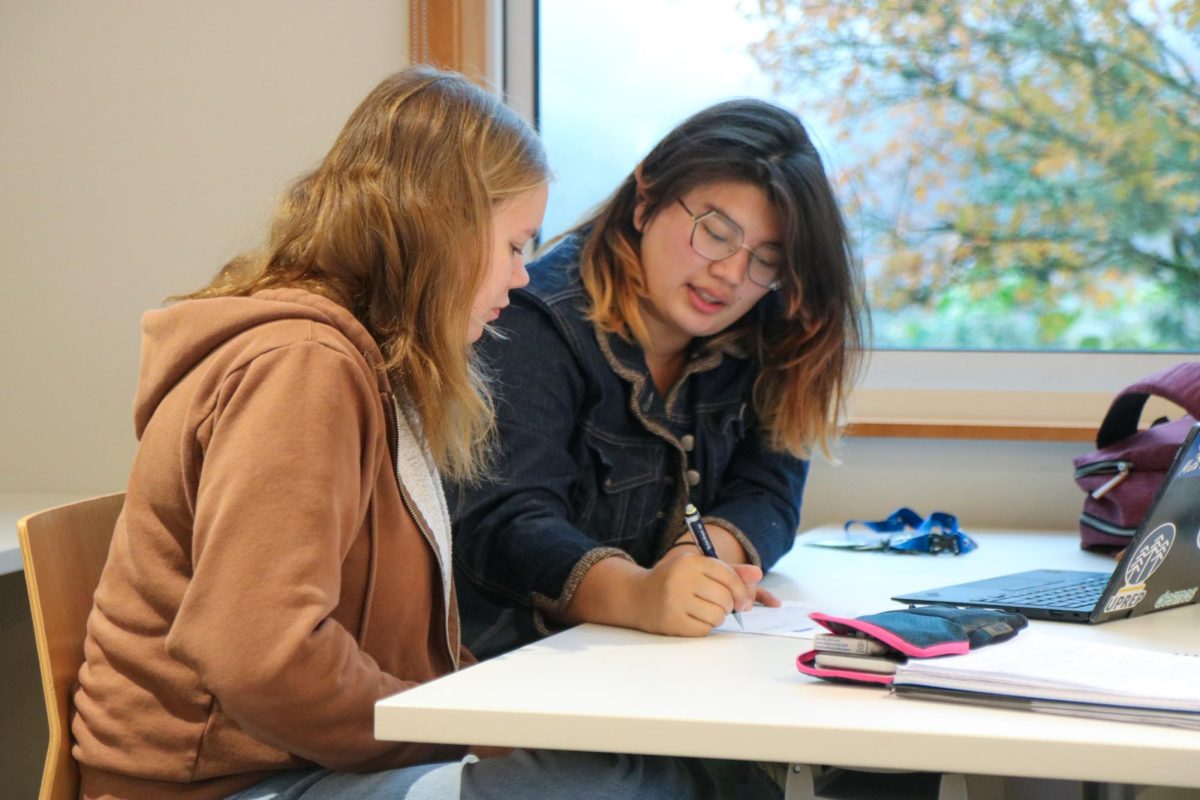
This school year, seniors Larissa Rosenthal and Maiya Duncan decided to rework UPrep’s Math Helpers program into Math Center.
Math Center focuses on offering support in a variety of subjects, such as algebra, geometry and calculus.
“In Math Center, we have different students who are interested in offering peer math help to other students, and we divide them up into different math subjects where they can help out,” Rosenthal said.
In previous years, Math Helpers was predominantly a faculty-run program, and there was less student leadership compared to in Math Center.
“The last two years, Math Helpers was former Math teacher Kira Rivera’s responsibility, and she recruited students to help,” Rosenthal said. “There were students who held leadership positions in Math Helpers, but it was really run by the teacher.”
Rosenthal and Duncan created a survey and posted it on Schoology in September. They wanted to gather feedback on what changes the student body would like to see in Math Helpers as it shifted to Math Center. They hoped that the rebrand from Math Helpers to Math Center would create a more welcoming and accessible environment, and help increase interest.
“Based on the survey we created, a general consensus was that people were interested in having it aimed towards test help,” Duncan said.
Duncan and Rosenthal also received responses on the timing and location of Math Center. Instead of hosting Math Center in the math classrooms during Community Time, like Math Helpers, Duncan and Rosenthal decided that Math Center should run before school, from 7:45 a.m. to 8:15 a.m. in the commons meeting room, nicknamed The Fishbowl.
“Last year, we used to run Math Helpers in one of the math classrooms, and students felt like that was a little bit less accessible and that The Fishbowl was a more centralized area,” Duncan said.
Since Math Center is still a relatively new program, Rosenthal and Duncan are still trying to work out some of the minor problems.
“I think we’re still trialing it,” Duncan said. “We have a lot of helpers who are interested in assisting people with math, but there’s been a little bit less student interest than we’d liked.”
As they look towards the future, Rosenthal and Duncan are hoping to continue making tweaks to the program, especially as it pertains to attendance.
“I think it’s has kind of been a little bit of the opposite of what we were expecting, where students who are in generally higher math classes, like calculus, are the ones who have been coming in for help,” Duncan said. “So that’s something we need to consider for the future.”
