

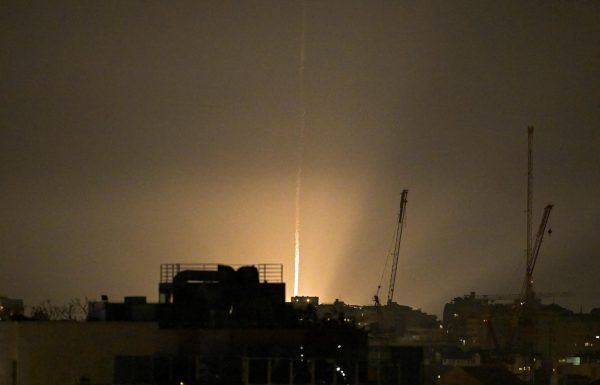
The U.S. and Israel initiated a joint missile strike on military infrastructure and leadership across the Islamic Republic of Iran, on Feb. 28.
The missiles struck infrastructure such as nuclear facilities and military bases, alongside targeting Iranian leadership in Tehran. The first wave of strikes killed Iran’s supreme leader, Ayatollah Ali Khamenei. Iran has since retaliated with attacks on US military bases in middle eastern countries, including Saudi Arabia, the UAE, Oman, Bahrain, and Kuwait.
As the middle east erupts into conflict, UPrep students are divided in opinion. Some lean toward supporting Iran while others lean towards Israel and the USA. What is widely agreed upon, however, is that starting an armed conflict is not a good idea. This opinion is echoed the strongest by students with family in Iran, such as junior Naysan Sedghi.
“I’m definitely concerned for my family’s safety, not only from the government but also from outside forces,” Sedghi said. “Because the missile strikes didn’t just hit the Iranian military facilities, they hit civilian targets as well.”
Caught in the crossfire of the airstrikes were the students and staff of an all-girls primary school in Minab. The strike killed over 160 people, according to Amnesty International. The US Department of Defense denied involvement during a public briefing on March 4, although investigations conducted by CBC, Al-Jazeera and domestic news agencies claim that the warhead used was an American Tomahawk missile.
“That could have been my family,” Sedghi said. “They’re definitely at risk.”
Sedghi’s family is of the Baha’i faith, a religious minority persecuted by the Iranian government, according to Human Rights Watch.
“In times of war, the Baha’i are not prioritized as much as regular citizens,” Sedghi said. ”They don’t receive the same medical attention.”
Although the destruction of Iran’s Islamic government would be beneficial to the Baha’i, Sedghi and his family do not believe that violence is the answer.
“It’s part of the religious texts that any conflict should be met with understanding.” Sedghi said. “There’s always going to be a better way to implement peace than destruction and violence.”
Sophomore Solomon Merati, who also has family in Iran, worries for their safety.
“My family’s mostly from the northern region, pretty rural, but there are definitely some in Tehran and Isfahan.” Merati said. “I’m definitely worried for them.”
Merati believes that Iranian regime change is a positive thing, but the US intervention has been bad.
“It’s good news whenever the guy that oppressed, killed, 35,000 of your people is killed,” Merati said. “Fundamentally there are [ways] to incite change, but a war is not a particularly good one.”
Sophomore Mikael Harmelin grew up in Israel, and still has close family there. From a young age, airstrikes from hostile countries had been a looming threat.
“When I was a kid, I had to hide in shelters all the time because of bombs,” Harmelin said. My room was a bomb shelter, it was made so that if there were any immediate dangers, we could all go into it.”
Harmelin recognizes the importance of national defense and military service in Israel.
“We’re very proud of protecting our land,” Harmelin said. “It’s honorable to do that sort of thing.”
However Harmelin believes that in this instance military escalation was not the answer.
“I think that there is a way that we could do this with negotiations,” Harmelin said. “But instead, we went ahead and escalated straight out of the gate, and that’s not the right way to respond.
Ninth grader Jeevi Anand also believes that President Trump hasn’t properly de-escalated the situation, citing the withdrawal from the JCPOA as an example of Trump’s reckless foreign policy.
““[The JCPOA] was working quite well.” Anand continued. “Iran wasn’t developing nuclear programs, wasn’t developing the threat of missiles.”
The Joint Comprehensive Plan of Action, or JCPOA, was negotiated between Iran and other countries such as the US, Russia, and the UK, for the purpose of limiting Iran’s nuclear program in return for sanctions and provisions. It came into effect in January of 2016, during the last year of President Obama’s second term. The JCPOA was criticised by some American allies, most notably Israel. On May 8 2018, during President Trump’s first term, he withdrew from the deal and put heavy sanctions back onto Iran, claiming in an address that the deal was one-sided, and failed to properly restrict Iran’s nuclear program.
Other students also believe that US military action is less than helpful.
“I’m obviously not in support of the Iranian government. They’re authoritarian. They’re doing a lot of bad things. That said, bombing school children is not the answer,” sophomore Leo Roth said.
“It’s good news whenever the guy that oppressed, killed, 35,000 of your people is killed,” Merati said, “Overall given the context and the additional civilian casualties, I don’t think that it’s positive.”
Roth believes that change to the Iranian government should come from within, instead of being fueled by foreign intervention.
“Fundamentally there are other ways to incite change; a war is not a particularly good one,” Merati said.
“[A democratic Iran] would have a little bit less of the anti semitism that’s currently baked into the regime,” said Roth, “that could leave Israel in a safer position.”
Freshman Jeevi Anand agrees that foreign intervention will not help the situation.
“U.S. intervention usually leads to further destabilization,” Anand said.
In 1953, the CIA helped to plan and execute a coup against elected Prime Minister Mosaddegh because he was nationalizing the oil industry.
“The whole reason we have this horrible regime in Iran is because we couped them in 1953.” Anand said. “We’ve seen the same thing in Libya, In Syria, and in Iraq.”
Anand believes that no side in this conflict has the moral high ground.
“It’s [a war] between a genocidal person, a narcissist, and then an autocratic dictator,” Anand said.
The conflict has also impacted UPrep global programs. Brian Gonzales, the Director of Global Link at UPrep, rerouted the flights for Global Link Botswana because of unsafe airspace.
“We determined that flying through our airport that we had booked through was not going to be a feasible option,” said Gonzales.
The flight, originally connecting to Botswana through the Doha airport in Qatar, has been cancelled due to the airstrikes. Though Gonzales wants to make the trip happen, his first priority is student safety.
“When changes like this happen, we do our best to look after the student’s well being and needs without impacting the demands on the families for this program,” said Gonzales.
Global Link Botswana will leave on April 7 and return on April 18, through Heathrow International Airport in London.
The Iran War has affected UPrep students very differently. Some students have relatives in Iran, others have family in Israel. Despite these differences, polling data shows that 81% oppose military action.
“Military intervention that killed innocent people never should have happened.” Sedghi said. “There’s always going to be a way to resolve conflicts peacefully. Governments and people are too impatient to wait for that to happen.”

