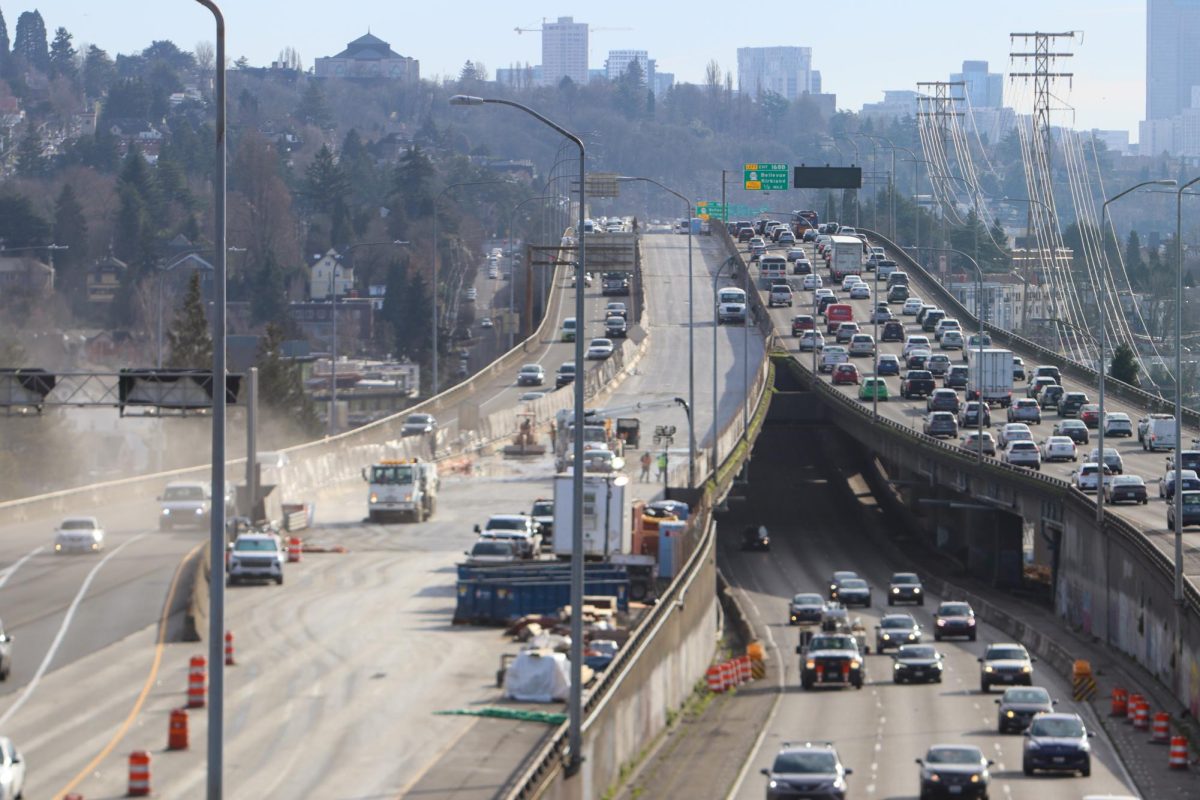
Along Interstate 5, traffic is reduced to a standstill, dust billows into the air and construction trucks go back and forth along the bridge’s three closed lanes. As senior Chase Sylvester drives to school, his car remains motionless amid the congested paths.
For the next year, I-5 on the Ship Canal Bridge will be restricted to two northbound lanes, and the express lanes will only be open northbound. The project will take a pause during the World Cup to avoid traffic. In 2027, the construction will pivot to southbound lanes as workers continue repairs to the upper deck.
 “It’s really only the difference of a couple of minutes, but it is very jarring going onto the highway, and it’s always a standstill for the first couple of minutes,” Sylvester said.
With the lane closures along the busiest section of I-5, according to the Washington State Department of Transportation, Sylvester, who commutes to school from Broadmoor, has to plan ahead so he reaches his destinations on time.
“If I’m going to other places, going north, I probably want to budget five to 10 minutes just to make sure, just in case I get caught in the midst of a really bad leg of it,” Sylvester said.
The lane closures have especially affected learning specialist Sharon Merrifield, whose commute from Poulsbo, takes up to two hours each way.
“The fastest way for me to get to and from school when I get off the [Kingston] ferry is to take I-5,” Merrifield said. “But since the lane closures, particularly in the morning, because they’re not opening the express lanes for I-5 south, I no longer take the interstate to school in the morning.”
Because she takes the ferry, Merrifield cannot leave her house early. She often gets to school later in the morning than she did before the closures.
“I essentially get to school probably 10-15 minutes later than I normally would,” Merrifield said. “It just lessens the amount of time that there is to do things because I’m constantly trying to balance getting enough sleep and pursuing personal things.”
Sophomore Fritzi Weissinger, who commutes from Blue Ridge, is a new driver, and the I-5 lane closures pose a challenge for her.
“I’m learning how to drive, and it’s a lot more stressful,” Weissinger said. “Usually [it took] like 20 minutes. It is now closer to 30 or 35 on a really bad day.”
During January intensives, field trips happened daily, and this year, transportation manager Andy Richardson was faced with bus schedule challenges because of the I-5 lane closures.
“We had what normally takes 10 minutes to get onto the freeway, taking sometimes an hour,” Richardson said.
To solve this problem, Richardson had to adjust the bus departure times to avoid the traffic on the I-5 southbound.
“We decided, okay, we’re going to wait 30 minutes, and we’re going to go 30 minutes later. And by that time, enough volume had decreased,” Richardson said.
During the regular school year, Richardson oversees sports transportation, sending teams to schools around the Seattle area. Their routes are most affected going southbound, and thus, Richardson has to adjust the bus schedules depending on which direction buses are headed.
“For after school, we’ve been giving them about an extra 10 or 15 minutes to get to their destination,” Richardson said. “If they’re going northbound, we’re not giving them any extra time because that doesn’t seem to be impacted.”

Even though she sometimes spends two hours commuting to and from work, and the closures have increased her driving distance and commute time, Merrifield says that it is worth it.
“People will ask me, I don’t know how you do that. I don’t know why you would do that,” Merrifield said. “I wouldn’t do it if I didn’t really love the school and love what I do.”