

In 39 years, a lot happens. People are wed, children grow up, lives are lost, and the world changes. In the 39 years since 1987, a friendship formed between Dean of Faculty Ty Talbot and substitute Stephen Ringo.
When they first met, Talbot was an eighth grader and Ringo was in his thirties. In the halls of St. Mark’s Lutheran Church, the two were paired up as mentor and mentee, and became friends for life.
30 years later, that bond deepened when Talbot donated his kidney to his friend.
In 2013, doctors diagnosed Ringo with IgA Nephropathy, a degenerative disease that slowly removes the kidney’s ability to filter toxic compounds.
“I felt sort of shocked,” Ringo said. “I try to roll with punches like that… and I try to present outwardly as rational, but I was scared.”
When Talbot first heard about his friend’s problem, he immediately volunteered fora transplant. “We were hanging out right after he got that news, and I said, ‘Well, count me in. You know, if you need a kidney I’d be willing to be a donor,’” Talbot said.
 As time went on, Ringo’s condition reached a breaking point and Talbot’s decision solidified at the sight of his friend in that condition.
“He was in bad shape,” Talbot said. “You know, I think his kidney function was down around 10% probably.”
Kidneys are filters to your body, getting rid of waste and excess fluid.
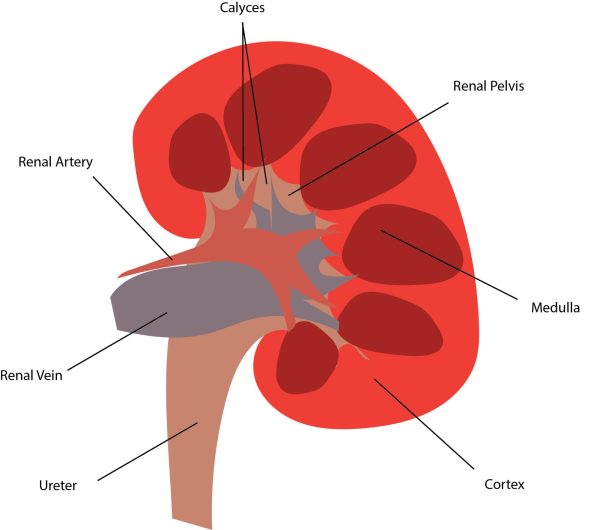
 “It’s like you’re poisoning yourself from inside, basically,” Talbot said. “It was going to result in him either going on dialysis at some point [or needing a transplant].”
Dialysis is a life-sustaining treatment that makes up for kidney failure by assigning a machine to do the kidneys’ job.
“Luckily, I had a donor named Ty so I did not have to do dialysis, which is a big bonus,” Ringo said.
Avoiding dialysis adds three to four years to Ringo’s predicted lifespan. Having a living donor who was compatible with Ringo gave his family hope for future treatment.
“We were very lucky… Ty was the best match, which was amazing, age, health, compatibility, longevity of the kidney,” Ringo’s wife, art teacher Bretta Ballou Ringo said.
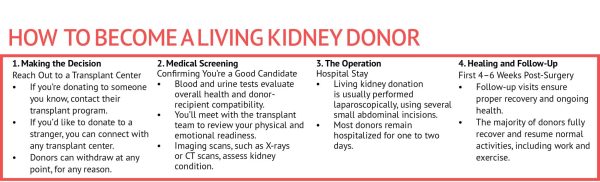
In the weeks leading up to a kidney transplant, donors are urged to maintain a healthy lifestyle to ensure that surgery goes well. On Jun. 5, 2019, Talbot and Ringo both went through the operating doors in hopes of a successful transplant.
“I felt kind of confident, you know?” Ringo said. “Doing it together and the way my wife is so supportive… I felt like this is a team thing, and we’re going to make it.”
Surgery is harder on the donor than it is on the recipient, according to Talbot. First, they have to cut open the donor’s side and extract the kidney. After, they go to a different room to slot it into the recipient’s urinary tract.
“It’s interesting when you donate a kidney, because you feel a lot worse, but the person who gets the kidney instantly feels a lot better,” Talbot said.
Recovery can take weeks. However, it was a smooth process for Ringo and Talbot.
“Stephen’s really healthy,” Ballou Ringo said. “He’s been a long-distance runner since middle school. He still runs like every other day… he’s lucky with that. Not having dialysis is a game changer.”
Though kidney donation is often viewed as a one-sided transaction, Talbot believes that the relationship between donor and recipient is mutual and that this relationship will only continue to grow stronger.
“It wasn’t something that I ever kind of imagined doing, but it just sort of came to both of us,” Talbot said. “I look back on it now as a gift to me too, to be able to do that with a friend.”

