
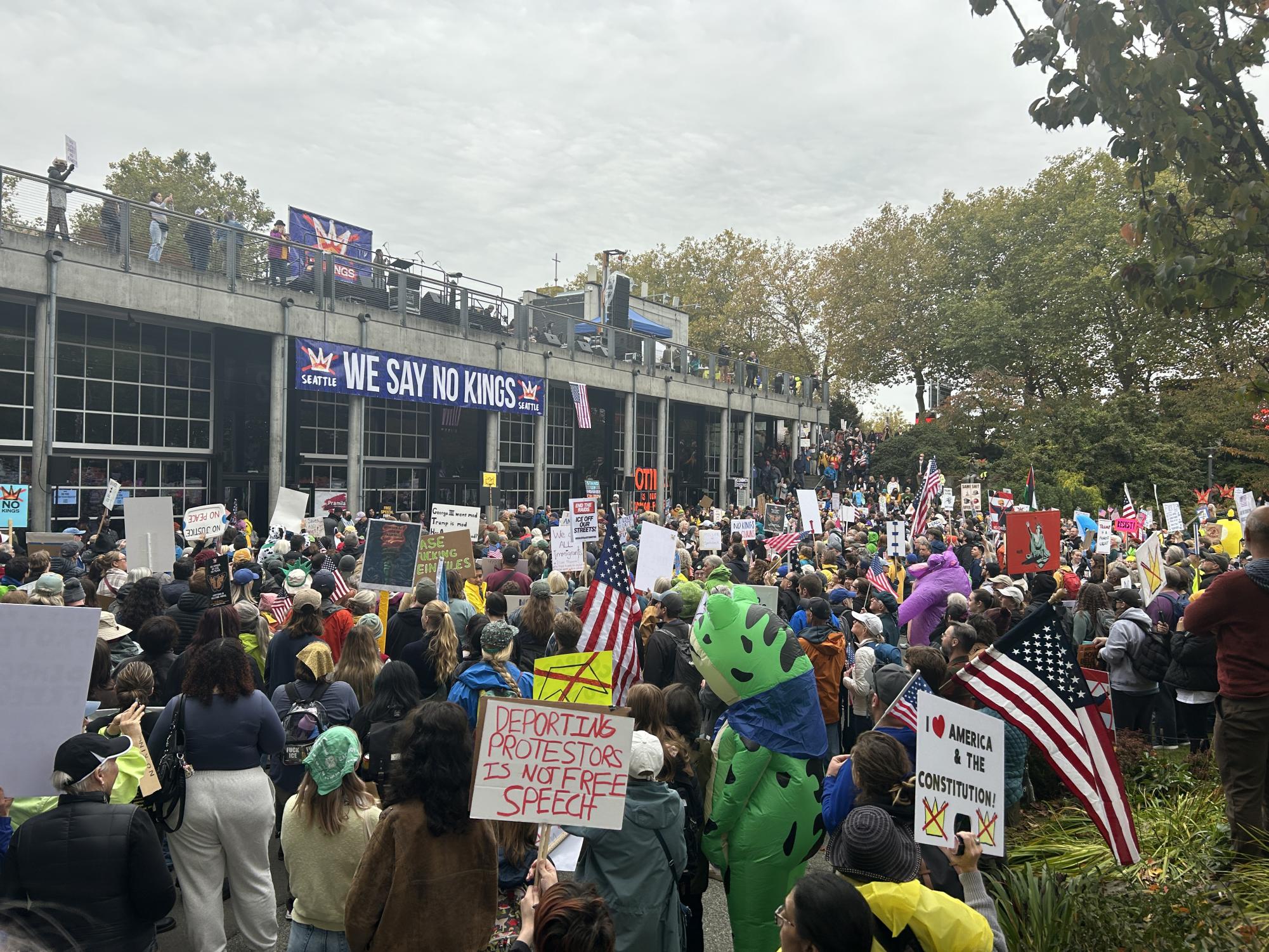


A mass of people surrounds junior Elliot Jossem at Seattle Center. Children, adults, senior citizens and people in dinosaur costumes have one thing in common today: they are here to protest President Trump and his current administration. On a tall stage, speakers like U.S. Rep. Pramila Jayapal D-Seattle, speak against the current executive branch.
“Being around so many like-minded but also motivated and dedicated people, was just reassuring and empowering, and it’s hard to describe,” Jossem said. “ You can just feel the power around you.”
According to No Kings Organizers, more than seven million people participated in the protest on Oct. 18. Across 2,700 cities and towns, peaceful protests compared the actions of President Trump to those of a monarch— hence the name “No Kings”.
Sophomore Holden Sposato attended the protest at the Seattle Center, which, according to No Kings organizers drew 90,000 participants.
Many participants brought signs and wore costumes to the protest.
“My dad went in the frog costume, and there were lots of cries of frogs together strong,” Sposato said.
The frog costume originated from a viral video of a No Kings protester in Portland, Oregon. Sposato saw several other people wearing costumes.
“I saw a couple of Captain Americas,” Sposato said. “I saw some dudes dressed up as George Washington and some other founding fathers. I saw a lot of lobsters.”
Science teacher Moses Rifkin attended the No Kings protest in Portland with his relatives.
“Walking there to meet my family was really emotional for me,” Rifkin said. “It feels like, ‘Oh, we’re all like, in it together.’”
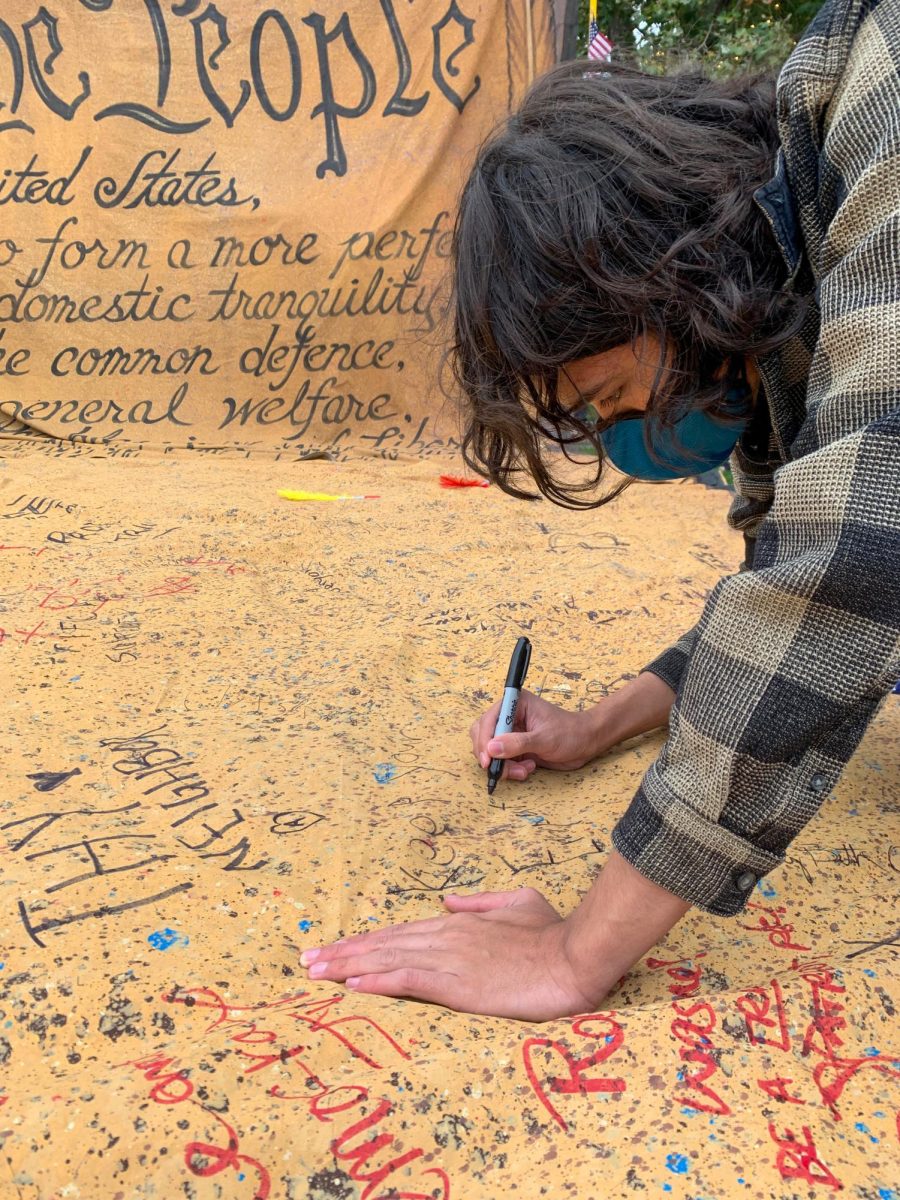
Sophomore Nira Jain-Julian, a member of the Conservative Centrist Discussion Club who identifies as right-leaning, did not support the protests.
“If there was a king and we lived in a monarchy, you wouldn’t be able to protest about having a king,” Jain-Julian said. “I don’t think it’s really a worthwhile cause.”
Jain-Julian viewed the protests as inconvenient.
“A lot of these protesters are, like blocking roads and standing on corners, and it’s kind of just annoying,” Jain-Julian said. “All the honking and it’s just making life harder for everyone. “
Jossem participated in the No Kings protest at the Seattle Center because he disapproves of the executive branch’s deportation policies.
“I can’t see you zip tie kids and think you’re a good person. I can’t see you destroying people’s lives and think you’re a good person,” Jossem said.
Senior Aslan Malik also disapproves of the Trump administration’s policies; however, he doesn’t see action reflected in the protest’s participants.
“I don’t think you can claim to be a sort of middle of the road liberal and then also claim that you want things to drastically change, because your ideology doesn’t subscribe to drastic change,” Malik said. “How, as a community, are you supposed to influence anything? You’re just going to show up with a sign and wave.”
Malik advocated for greater action among the protesters, like joining Democratic organizations, calling representatives and volunteering in their community.
“We need to be realizing that this is not practical politics,” Malik said. “Practical politics can’t just be going out on the street and having a sign that has Trump on a toilet. It needs to be throwing your support behind actual progressive candidates.”
Seattle No Kings protest organizer Tyna Ek, however, advocated for the importance of protests.
“Historically, almost every social change we’ve made in this country has come from protests. You know, it began with protests,” Ek said. “From the women’s vote to civil rights, to gay rights, to labor rights, ending the Vietnam War.”
Protests are just one tactic that the No Kings movement uses, according to Ek.
“I mean, we set up meetings every month with our legislators and their staffers. We’ve been doing that for years,” Ek said. “There’s just a lot of things that you can do. Protests are one of those tools.”
Rifkin uses that tool.
“It made me feel good, and I think that’s an achievement,” Rifkin said. “I can feel kind of varying degrees of frustrated or mad or disheartened, and I felt more energized after it, and I think that’s valuable.”
Ek helped plan the protests in Seattle, in hopes of educating citizens about their rights.
“We want people to know that if we stand together, we have a much better chance of saving, really, a government that’s for the people,” Ek said. “We’re trying to get people to get used to actually living the value that this is a self-governing nation by the people. Get people more involved on a daily basis in their own government.”